The Final Gavel in Kansas and the May Sprint in the Show-Me-State

We have reached the pivot point of the legislative year for the two-state region. Topeka officially adjourned sine die in mid-April, while Jefferson City is racing the clock against its 6:00 p.m. May 15 constitutional deadline.
For businesses, associations, and political stakeholders, understanding what survived the legislative gauntlet—and what is currently stalling out—is critical for forecasting the rest of the year. Here is the unvarnished reality on the ground.
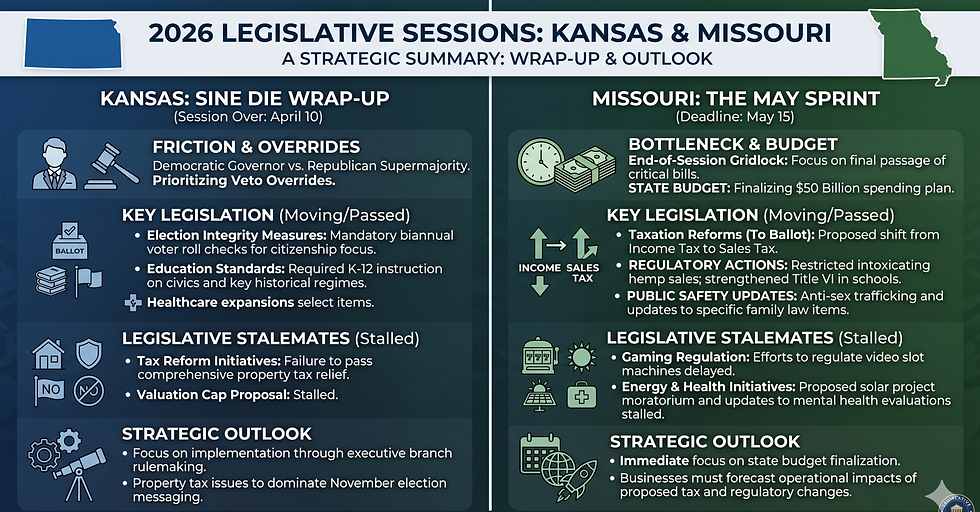
Kansas: Veto Overrides and the Property Tax Void
The Kansas Legislature officially wrapped its 2026 session on April 10. Defined by the predictable friction between a Democratic governor and a Republican supermajority, the final days were dominated by high-stakes veto overrides and a few massive policy stalemates.
Election Law Overhauls: The supermajority successfully overrode Gov. Laura Kelly’s veto on HB 2437. The new law mandates that the Secretary of State conduct biannual checks of the state’s voter rolls against the federal SAVE database to flag potential noncitizens for removal. However, the legislature did not secure overrides on everything; vetoes were sustained on HB 2569 (which would have altered absentee voting rules) and HB 2587 (concerning provisional ballots for those with noncitizen driver's licenses).
Education Mandates: K-12 education policy saw major shifts with the passage of HB 2412. The bill mandates secondary instruction on the histories of communist, socialist, and fascist regimes, and requires students to pass an American civics exam modeled on the naturalization test to graduate high school.
The Property Tax Stalemate: Despite entering January with massive momentum, comprehensive property tax reform fell short. SCR 1616—a proposed constitutional amendment to cap real property valuation increases at 3%—faced intense pushback from municipalities and agriculture groups concerned about the tax burden shifting to commercial land. The effort ultimately collapsed, leaving a significant void in the state's tax relief portfolio.
Missouri: The Final Countdown to May 15
Across the state line in Jefferson City, lawmakers are staring down a massive bottleneck. With only 19 policy bills passed as of late April, the sheer volume of unfinished business guarantees a chaotic final three weeks. The oxygen in the room is currently being consumed by the constitutional requirement to pass a $50 billion state budget by May 6.
The Income-to-Sales Tax Swap: The most economically disruptive measure of the session is officially headed to the ballot. Lawmakers passed a proposed constitutional amendment that will ask voters to eliminate the state individual income tax entirely and replace the revenue by expanding state sales taxes on certain goods and services. If approved by voters, this will fundamentally rewire Missouri's economy and business operations.
Targeted Regulations Passed: Despite the slow pace, the legislature has successfully inked several high-profile measures. This includes restricting intoxicating hemp products strictly to licensed marijuana dispensaries, enacting Title VI protections against antisemitism in public education, passing a wide-ranging anti-sex trafficking package, and legally allowing pregnant women to finalize a divorce.
What is Falling Behind: With floor time at a premium, several major initiatives are losing momentum. Efforts to restrict video slot machines in gas stations, a moratorium on the construction of solar projects (SB 849), and a critical bill to address the massive backlog of crime suspects awaiting mental health evaluations are all struggling to advance before the clock runs out.
The Strategic Takeaway
For organizations operating in Kansas, the legislative book is closed, and the battleground immediately shifts to executive branch rulemaking and the November elections. Without a comprehensive property tax relief package to tout, expect a volatile campaign cycle where the state budget surplus is heavily weaponized by both parties.
In Missouri, the final weeks of session will dictate the state's regulatory environment for the next decade. While the $50 billion budget is the immediate hurdle, the passage of the income tax elimination amendment means every business entity in the state must begin forecasting the operational impact of a vastly expanded sales tax framework. It will be the single most consequential ballot initiative of the year.


Comments