Missouri Income Tax Elimination Bills: What's the Status?
Updated: Feb 17
Despite a flurry of activity in the Commerce Committee last week, HJR 173 and HJR 174 have yet to clear the first official legislative hurdle. The sheer volume of feedback—630 submissions in total,—highlights the intensity of this debate, with 96% of those voices urging lawmakers to reject the transition to a service-based tax model.

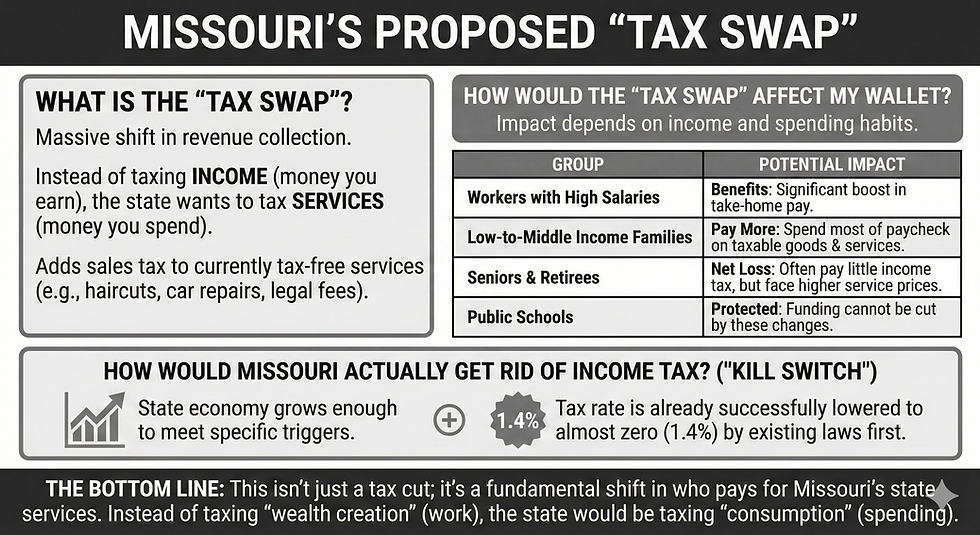
The two main tax proposals: HJR 173 (Rep. Bishop Davidson) and HJR 174 (Speaker Jonathan Patterson) are under consideration by the legislature. Both measures aim to fundamentally rewrite Missouri’s economic DNA by eliminating the state individual income tax and replacing that revenue through an expanded sales tax base. There seems be alignment on the "what," but a fierce debate on the "how" and the "who."
The Core Conflict: Growth vs. Equity
The conversation is currently split between two powerful narratives:
The Proponents' View (Economic Competitiveness): Supporters argue that abolishing the income tax is the only way to remain competitive with "no-income-tax" neighbors like Tennessee. By moving toward a consumption-based model, they believe Missouri will attract high earners and business owners, ultimately fueling long-term growth.
The Opponents' View (The "Regressive" Swap): Critics, many groups who testified, warn of a "winners and losers" effect. Because lower-income families and retirees spend a larger share of their checks on newly taxable services—like car repairs, haircuts, and streaming—they could face a net tax increase despite the income tax savings.
What’s At Stake for Your Industry?
These bills don't just change rates; they repeal a 2015 constitutional ban on taxing services. If passed, a massive "multibillion-dollar hole" left by income tax revenue would be filled by taxing industries that have enjoyed exemption.
The "Service Expansion" list is extensive, potentially covering:
Professional Services: Legal fees, accounting, and consulting.
Personal Care: Haircuts, gym memberships, and pet grooming.
Home & Auto: Mechanic labor, plumbing, and landscaping.
Digital Life: Streaming services and SaaS subscriptions.
The state wants to stop taking money out of your paycheck but will start charging you sales tax on services you use every day.
The Big Trade-Off
The "Payday" (Good News): By 2031, state income tax would be 0%. You would keep more of your gross salary.
The "Checkout" (The Catch): To pay for this, the state would start charging sales tax on labor and services that used to be tax-free.
How Will This Affect Your Wallet?
Projections show the impact depends on your income and what you buy:
Low-wage families and those on fixed incomes (like Social Security) already pay little to no state income tax because of standard deductions and exemptions. For them, there is no "savings" to offset the new costs. BUT, the daily costs add up quickly for folks with limited resources: Families living paycheck-to-paycheck would face immediate price hikes on essential labor services—such as car repairs, laundry services, and home maintenance—that are currently tax-free.
Low-Moderate Income Families: A family earning ~$65,400 might see a net gain of $30–$80 per month. However, some analysis suggests a potential net loss of $535 per year due to the rising costs of daily services. Think: your house cleaning, your accountant, and lawn care.
Seniors & Retirees: This group may be "losers" in the swap. Many retirees already pay little to no income tax on Social Security, so they don't save much money, but they will still pay the new taxes on things like plumbers and haircuts.
High Earners: Those making over $172,000 likely benefit the most because their income tax savings will be much larger than any extra sales tax they spend.
What happens next?
The bill has yet to make it out committee. To pass the "tax swap," Missouri lawmakers must first secure a strict constitutional majority in both the House and Senate, which is difficult given the massive $8 billion revenue shift. In the Senate, the bills face a high risk of a filibuster from a bipartisan group of critics concerned about the impact on rural communities and state services. Even if passed by the legislature, the Governor cannot sign these into law; instead, they must be approved by a majority of Missouri voters at the ballot box. Finally, under the Speaker’s version (HJR 174), the entire plan is legally blocked unless the state’s economy successfully triggers a drop in the current tax rate to below 1.4% first.
Lastly, while the HJRs authorize the expansion of the sales tax base to services, the specific list of which services get taxed would be determined by subsequent legislation, so there are many unknowns that are leaving folks weary.



Comments